
Beneath the Stone: The Hidden Physics That Makes Olympic Curling So Mesmerizing
Why the sport that looks like sweeping ice is actually a complex dance of friction, momentum, and strategy.
To the casual Winter Olympics viewer, curling might appear deceptively simple: athletes slide stones down a sheet of ice while teammates frantically sweep the path ahead with brooms. Yet this centuries-old Scottish pastime, now a mainstay of the Winter Games, is a masterclass in applied physics, intricate teamwork, and razor-sharp tactics unfolding on a meticulously prepared frozen stage. Beneath the seemingly slow pace lies a dynamic interplay of forces that turns granite stones and ordinary brooms into instruments of precision.
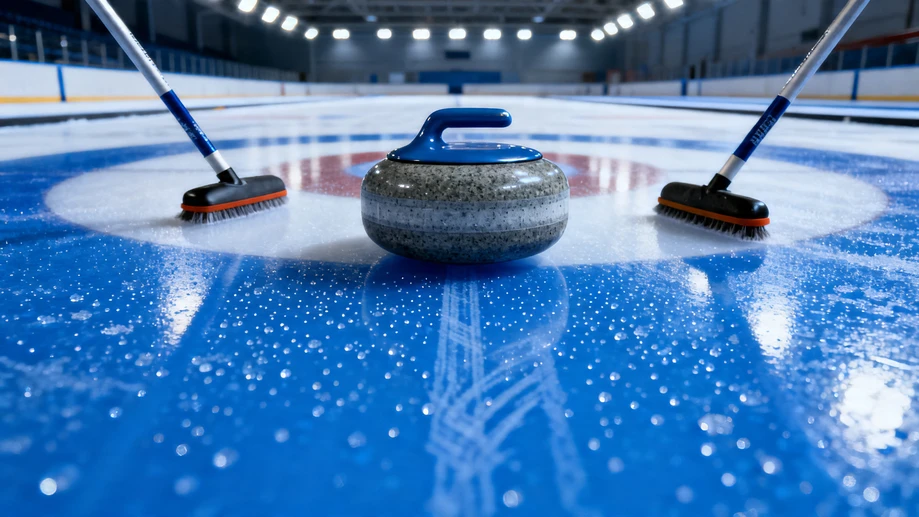
The magic begins with the ice itself – far from a smooth surface. Olympic curling ice isn't a flat pane; it's intentionally "pebbled." Before competition, droplets of water are sprayed onto the ice sheet, freezing into tiny, bead-like bumps. This pebble creates a crucial point of contact for the granite stone's concave running band. As the heavy stone glides, it rides on these pebbles, significantly reducing the friction compared to flat ice. However, this friction isn't static. It changes constantly based on factors like the stone's speed, rotation, and, critically, the temperature of the ice beneath it, creating a fluid and unpredictable playing field.
This is where the sweeping revolution comes into play. Sweeping isn't just about cleaning debris; it's intense, strategic friction management. When sweepers vigorously brush the ice immediately ahead of the moving stone, they accomplish two key physical feats. Firstly, the friction from the broom head generates heat – enough to slightly melt the very top layer of the pebbled ice, creating a microscopically thin film of water. Secondly, the sweeping action polishes this path. This combination of temporary melting and polishing drastically reduces the friction the stone encounters. Sweepers effectively create a faster, "slipperier" track for the stone, allowing it to travel farther and curl less than it naturally would.
Precision sweeping demands extraordinary athleticism and communication. Sweepers must maintain intense pressure and speed on the broom head, sometimes reaching heart rates comparable to sprinters. Crucially, they work in perfect concert with the skip (team captain) stationed at the far end of the sheet. The skip reads the stone's trajectory, speed, and potential curl, rapidly shouting commands to the sweepers – "Hard!" "Clean!" "Whoa!" (stop sweeping) – to fine-tune its path millimetre by millimetre. This split-second dialogue, interpreting complex physics in real-time, is the sport's nerve centre.
Understanding these forces transforms the viewing experience. What seems like gentle sliding becomes a high-stakes calculation of vectors, friction coefficients, and thermal dynamics. Every subtle rotation (the "curl") imparted by the thrower, every burst of sweeping, every nuanced adjustment for changing ice conditions is a deliberate manipulation of nature's laws. The strategic depth is immense, involving intricate shot placement, blocking opponents' paths, and complex scoring angles. Appreciating the hidden physics – the heat from the broom, the melting pebble, the controlled curl – reveals why curling is aptly nicknamed "chess on ice," a mesmerising blend of brute force, finesse, and intellectual brilliance played out on the frozen stage of the Olympic Winter Games.