
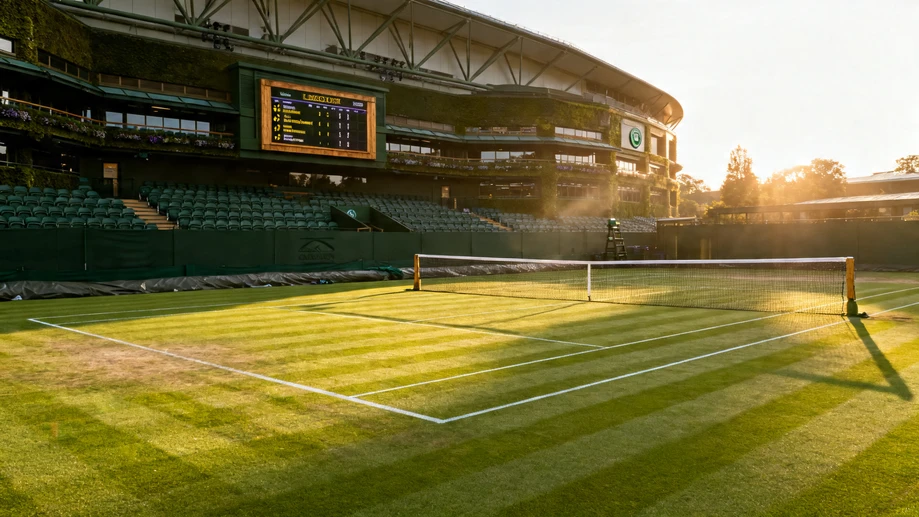
The Hallowed Turf: Wimbledon's Grass Court Legacy Through the Ages
How a 19th-century lawn game evolved into tennis's most revered surface at the All England Club
When Major Walter Clopton Wingfield patented "sphairistike" in 1874, few could imagine his garden party pastime would birth Wimbledon's sacred lawns. The All England Croquet Club's decision to allocate one lawn for this new "lawn tennis" in 1875 ignited a sporting revolution. Those original ryegrass courts hosted the first Wimbledon Championship in 1877, establishing traditions that would shape tennis history. Unlike clay's slow patience or hardcourt's predictable bounce, grass demanded lightning reflexes and daring net charges, creating tennis's most visceral theater.
Grass courts transformed tennis from Victorian recreation to athletic spectacle. Early players like the Renshaw brothers dominated with aggressive serve-and-volley tactics perfectly suited to the surface. The grass's natural inconsistencies rewarded intuition and punished hesitation, forcing constant tactical innovation. By 1922, when Centre Court opened at Church Road, Wimbledon's identity as grass tennis' cathedral was cemented. Even as other surfaces gained popularity, the Championships maintained their living link to tennis's pastoral origins through meticulous turf preservation.
Maintaining Wimbledon's botanical marvel requires scientific precision. Each court contains 100% perennial ryegrass cultivated on Surrey's sandy loam soil. The 8mm blades are cut daily during the tournament, with moisture levels precisely calibrated. Beneath the surface, a vacuum-powered drainage system removes 26,000 liters of water per hour, ensuring play continues through London's fickle summers. This marriage of tradition and technology preserves grass's unique characteristics while meeting modern athletic demands.
The grass surface profoundly influences tennis strategy and history. Serve-and-volley masters like Pete Sampras and Martina Navratilova built legacies on Wimbledon's lawns, their styles perfectly adapted to grass's low bounce. Contrastingly, clay-court specialists often struggled until the 21st century brought slower grass varieties. Even today, the surface creates dramatic upsets as underdogs exploit its unpredictable nature. That magical moment when a sliced backhand skids ankle-high remains grass tennis's signature thrill.
Modernization pressures have subtly reshaped Wimbledon's turf. Since 2001, 100% ryegrass replaced the traditional rye-fescue blend for improved durability. Court preparation now begins 14 months pre-tournament, with grow-lights supplementing English sunshine. Yet these innovations serve tradition, preserving grass tennis against homogenization. The All England Club's turf consultants balance playability with heritage, ensuring Centre Court still plays like its 1922 ancestor.
Wimbledon's grass represents sporting continuity in a changing world. While other Grand Slams embraced artificial surfaces, the Championships remain the ultimate test of adaptability. Players must recalibrate footwork, stroke timing, and tactics within days. This surface demands respect for tennis's history while rewarding modern athleticism. As new champions kneel to collect their trophies, they touch the same earth that launched tennis into the global consciousness.